The Big Churn: RTO Mandates, Performative Presenteeism, and the Age of Stealth Downsizing
Why blanket return-to-office mandates function as quiet layoffs, and what that costs the workforce that stays.
Every few years, the corporate ecosystem undergoes a structural purge under the guise of cultural renewal. In the early 2010s, it was the “agile transformation” that promised to dismantle silos but mostly succeeded in introducing the daily standup. In the post-pandemic era, the drumbeat is the Return-to-Office (RTO) mandate.
Executives line up in town halls to deliver identical, scripted monologues about the sacred nature of “serendipitous watercooler moments,” “spontaneous collaboration,” and the preservation of “corporate culture.”
But behind the gaslighting is a cold, mathematical reality. Rigid return-to-office mandates—particularly the unyielding demand for five physical days a week—are rarely about culture or productivity. They are a calculated instrument of stealth attrition: a friction-based downsizing strategy designed to trim the balance sheet without paying severance, triggering WARN Act disclosures, or taking a public relations hit for mass layoffs.
Welcome to The Big Churn. It is the silent filtering of the workforce, happening at the exact moment corporate theatre is being automated out of existence.
The Mathematics of Stealth Attrition
When an organisation needs to reduce its headcount by 10% to 15% to satisfy investors or adjust to shifting market dynamics, it faces two paths.
The first path is the traditional Reduction in Force (RIF). This path is expensive and highly visible. It requires paying out months of severance, managing legal liabilities, and handling the inevitable drop in morale. Worse, it signals to the market that the business is struggling, depressing the stock price and inviting negative press.
The second path is much quieter: Constructive Dismissal by Commute.
By mandating that everyone spend forty hours a week in a physical office, the organisation deliberately introduces friction into the daily lives of its employees. They know that parents, caregivers, and people who relocated during the remote-work era will find these terms unsustainable.
The corporate leaders are fully aware of this. In a comprehensive survey conducted by BambooHR, 25% of VP and C-suite executives and 18% of HR leaders openly admitted they hoped RTO mandates would lead to voluntary resignations. The workforce is not fooled either: 72% of employees suspect that RTO is a headcount reduction strategy in disguise.
We have already seen the extreme execution of this strategy. In August 2023, the dating app Grindr mandated a strict two-day-a-week in-office policy, giving employees a brutal two-week window to relocate near one of its newly assigned office hubs or quit. The result was clinical: 80 employees resigned, representing nearly 45% of the company’s entire workforce, decimating their engineering and product teams without a single formal layoff notice or severance package.
The math is simple and clinical. A predictable percentage of the workforce will resign voluntarily. They will walk away without a severance package, without filing for unemployment, and without a single headline in the financial press. The company achieves its headcount target entirely through voluntary attrition, maintaining the illusion of stability to the outside world.
But this strategy has a fatal flaw: attrition by friction is not selective. It does not filter out your low performers; it filters out your most mobile, high-agency talent—the individuals who have options in the market and refuse to tolerate corporate gaslighting. The people who remain are often those who cannot leave, or those who have mastered the art of surviving the office.
Performative Presenteeism and the RTO Paradox
The central irony of RTO mandates is that they do not deliver the productivity gains executives claim to seek.
In a landmark study, Dr. Mark Ma of the University of Pittsburgh analysed S&P 500 firms that implemented RTO mandates. The data was unequivocal: RTO mandates did not improve firm performance—measured by either revenue or stock price—but significantly hurt employee satisfaction and increased turnover. The study concluded that managers frequently use RTO mandates as a “power grab” and a convenient scapegoat to shift blame away from poor executive decisions.
When physical presence is mandated but actual, creative output is difficult for leadership to measure, the office environment defaults to a defensive posture: performative presenteeism.
In an office where you are judged by the hours your screen is illuminated rather than the outcomes you deliver, the primary objective shifts from doing work to being seen doing work. This has led to the rise of behaviours like “coffee badging”—where employees swipe into the office to satisfy tracking systems, buy a coffee to prove they were there, and immediately leave to work elsewhere.
And in this arena of corporate survival, the PowerPoint presentation is the ultimate shield.
Meet the “PPT Warriors.” These are the professionals whose entire career model is built on managing up, managing sideways, and managing perception. In the physical office, their days are occupied by meetings about meetings, and their nights are spent in the “Presentation Polish Panic.”
To the PPT Warrior, a slide deck is not a medium for conveying information; it is proof of life. It is visual evidence that they are “strategising,” “aligning,” and “synergising” cross-functional workflows. They will spend hours formatting boxes, selecting icons, and wordsmithing bullet points to ensure that a slide deck looks incredibly complex, signaling to management that the problem they are solving is too sophisticated for ordinary mortals.
In early 2024, Dell Technologies took this performative theatre to its logical extreme. Dell decreed that remote employees would be completely ineligible for promotions or internal transfers, effectively locking their careers. Despite this severe professional blacklist, internal reports indicated that nearly half (50%) of Dell’s US workforce chose to remain remote, accepting career stagnation over the performative tax of returning to the office. They chose to protect their actual quality of life over the illusion of corporate advancement.
The effort invested in these performative structures is wildly disproportionate to the insight they contain. It is a visual representation of a corporate culture that has replaced substance with activity—massive strategic coordination masking a complete absence of execution.
And the PPT Warriors are panicking because their shield is about to be vaporised.
The Slide-Builder’s Ruin: The Automation of Corporate Theatre
The ultimate irony of the PPT Warrior’s defence strategy is that generative AI is exceptionally good at their job.
For years, slide-builders justified their existence through their ability to synthesise messy data, structure arguments, and format slides. But these are precisely the capabilities that large language models have commoditised. Today, an AI tool can take a raw, unstructured voice memo or a bulleted list of notes and convert it into a polished, visually stunning corporate presentation in less than thirty seconds.
The synthesis is done. The formatting is aligned. The corporate jargon is automatically injected.
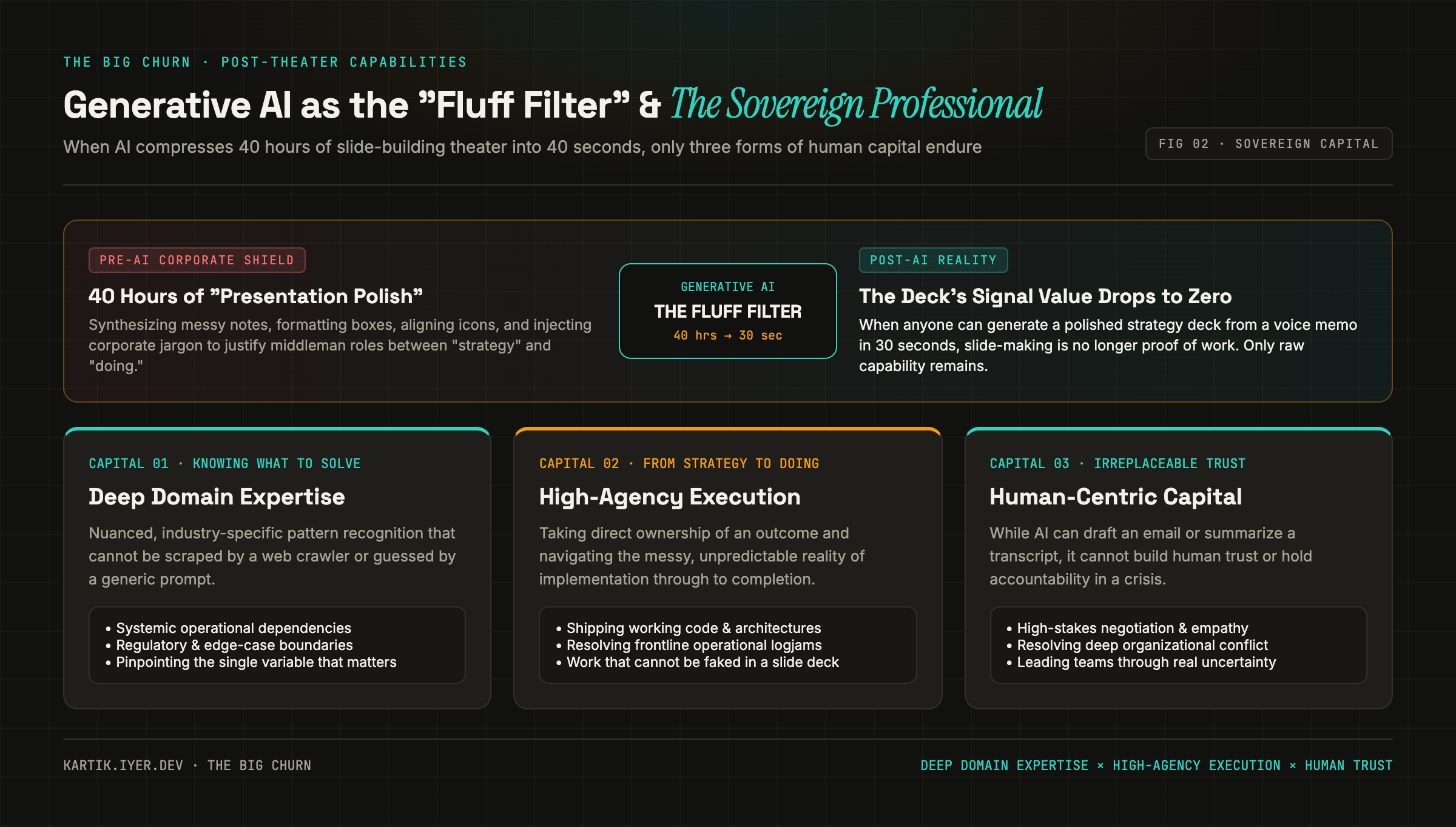
Generative AI acts as a “Fluff Filter.” When anyone can generate a polished strategy deck with a single prompt, the value of the deck itself drops to zero. The performance of slide-making is automated out of existence, and the corporate theatre that once protected the middleman is exposed as empty space.
When the fluff is stripped away, only raw capability remains. You can no longer hide behind an elegant presentation because the executive team knows you did not spend forty hours building it—you spent forty seconds prompting it. The middleman who lived in the gap between “strategy” and “doing” has run out of runway.
The Rise of the Sovereign Professional
As the Big Churn filters out those who refuse the commute and AI automates those who live by the slide, the corporate landscape is undergoing a massive shift from process to substance.
For the high-performing professional, this structural shakeup is a forcing function to transition from a corporate dependent to a Sovereign Professional—an individual who takes complete ownership of their time, health, and location in the face of institutional decay.
When the theatre is automated, only three forms of capital actually matter:
1. Deep Domain Expertise
Knowing what to solve, not just how to talk about it. This is the nuanced, highly specific, industry-adjacent knowledge that cannot be scraped by a web crawler or predicted by an LLM. It is the understanding of systemic dependencies, regulatory edge cases, and historical context that allows a professional to look at a complex system and pinpoint the single variable that needs to change.
2. High-Agency Execution
The ability to build, ship, close, or fix. This is the transition from “strategy” to “doing.” High-agency execution means taking responsibility for an outcome and navigating the messy, unpredictable reality of implementation. It is the practitioner who ships the code, the consultant who solves the hard operational logjam, or the dealmaker who closes the complex partnership. It is the work that cannot be done in a slide deck.
3. Human-Centric Capital
Complex negotiation, high-stakes empathy, and real leadership. While AI can draft an email or summarise a meeting, it cannot build trust. The ability to motivate real human beings, resolve deep-seated organisational conflicts, and lead teams through periods of intense uncertainty is the one capability that cannot be modelled in a spreadsheet.
The corporate theatre of slide-building and performative presenteeism served a purpose in a slower, more patient era. It allowed organisations to feel secure in their complexity. But the combination of stealth attrition through RTO mandates and rapid AI automation has brought that era to a decisive end.
The Big Churn is painful, but it is also a massive correction. It is stripping away the fluff, exposing the paper tigers, and forcing us to return to what has always mattered: raw, verifiable execution.
The choice before you is no longer how to survive the corporate theatre. It is whether you will remain a captive of it, or step out and build your own sovereignty.
How has the return-to-office mandate affected the actual outputs of your organisation? Are you building professional sovereignty, or are you still polishing slides for the theatre?
The Dutch Reckoning: AI Automation and the Sovereign Fiscal Architecture of the Netherlands
One-third of Dutch government revenue (€142B/yr) flows directly from employment contributions. What happens when 3.33 million white-collar roles enter the AI automation zone?
The 3-Layer Architecture: Directives, AI Orchestration, and Deterministic Execution
LLMs are probabilistic in an enterprise world that demands determinism. How separating Directives, Orchestration, and Execution makes AI reliable.
The Reality-Based Architecture Manifesto: Authentic Intelligence Over Organizational Theater
Why 25 years of corporate systems optimized for the appearance of progress are now colliding with AI — and how to re-architect the building itself.
The Art of AI-ing Better: Human Wisdom as AI Compass
AI amplifies whatever process it's bolted onto, broken or not. How 25 years of domain pattern recognition guides AI to compress six-month cycles into hours.