Swadharma in the Age of Silicon: Why AI is Like Dharma, and the User is Karma
From a Class 5 blazer badge in the Kumaon Himalayas to ten days of silence in Igatpuri: reclaiming Sanatana Dharma from politicized noise, and understanding why AI is a mirror of our own Karma.
From a Class 5 jerkin in the Kumaon Himalayas to ten days of noble silence in Igatpuri—a seeker’s inquiry into Sanatana Dharma, politicized noise, and the mirror of Artificial Intelligence.
I. The Badge Over the Heart (Nainital, Class 5)
At 7,800 feet on the Sher-Ka-Danda ridge in Nainital, the mountain mist does not drift in; it claims the ground. On winter and monsoon mornings at Birla Vidya Mandir, the Kumaon chill cut straight through your shirt before morning assembly had even begun. You pulled on your grey woollen jerkin, buttoned your navy school blazer over it, and smoothed down the heavy embroidered crest stitched over your left pocket—right above your heartbeat.
I was ten years old, in Class 5, when I first started staring at that badge and wondering what it was actually trying to tell me.

If you look closely at that 1947 shield, it is not a decorative piece of school branding. Whoever designed it at the dawn of Indian independence was encoding an entire cosmology into four quadrants:
- Top-Left (Indigo Field): A twenty-four-spoked saffron Dharma Chakra—the wheel of cosmic order in relentless motion.
- Top-Right (Gold-Green Field): A five-pointed interlaced star—representing the Pancha Mahabhuta, the five elemental building blocks of material reality and the human body.
- Bottom-Left (Cerulean Field): Beneath the snow-clad peaks of the Himalayas, a white Hamsa (swan) gliding across Naini Lake—the ancient Vedantic symbol of Hamsa-Viveka, the mythical swan said to possess the discernment to drink pure milk from a bowl of water mixed with milk, separating signal from noise, truth from illusion.
- Bottom-Right (Sky-Blue Field): A golden rising sun illuminating a pink Lotus (Padma) blooming above rippling waters—the symbol of awakened consciousness rising out of the mud of the world without ever being stained by it.
And anchoring all four quadrants at the bottom, on a curved green scroll, were three words in Devanagari lifted straight from the battlefield of Kurukshetra (Bhagavad Gita 3.35):
स्वधर्मे निधनं श्रेयः
Swadharme Nidhanam Shreyah
When you are in Class 5 and you ask the adults around you what Dharma means, almost everyone gives you the lazy translation: “Religion.” And if you ask what the motto means, they give you the martial translation: “It is better to die in your own duty/religion.”
Even at ten years old, standing on gravel wet with pine needles in the Kumaon hills, that translation did not compute.
If Dharma just meant “religion,” why was Krishna saying it to Arjuna when every single warrior on both sides of the Kurukshetra battlefield belonged to the exact same tradition and worshipped the exact same gods? Why would a school founded in 1947 stitch a verse onto a ten-year-old’s blazer telling him to perish in his Swadharma? What was my dharma as a ten-year-old boy struggling to keep his shoelaces tied and his ink pen from leaking in the mountain altitude?
I did not know it then, but that stitched piece of cloth over my left pocket had planted an open loop in my mind. It was a philosophical splinter that would refuse to come out for the next two decades—following me down from the hills of Nainital to the chaotic streets of Delhi, through graveyard shifts in early-2000s call centers, across corporate boardrooms in Sydney, into the kitchen of a 12-seat health-food café in Pune, and finally onto a silent meditation cushion in the Sahyadri hills in 2009.
And today, as I watch the world lose its mind over two seemingly unrelated things—the loud, politicized distortion of Sanatana Dharma on one hand, and the existential panic over Artificial Intelligence on the other—that Class 5 badge has come back into razor-sharp focus.
Because the more I build with frontier AI systems and observe how human beings interact with them, the clearer a single realization becomes:
AI is like Dharma—each person decodes it according to their own inner conditioning. And the user is Karma.
To understand why that sentence holds the key to navigating our technological future, we first have to rescue the word Dharma from the people shouting it the loudest.
II. Reclaiming Sanatana Dharma from the Political Megaphone
We live in an era of noisy reductionism. Turn on a television debate or scroll through a social media feed today, and you will see Sanatana Dharma treated either as a militant political identity badge by those who claim to defend it, or as a fossilized hierarchy of caste and ritual by those who attack it.
Both camps are fighting over a caricature. Worse, both camps have unconsciously adopted a Western, colonial template of what a “religion” is—a closed club with a fixed historical founder, an infallible book of commandments, a dress code, and a sharp boundary between “believers” and “outsiders”—and have tried to cram a five-thousand-year-old civilizational inquiry into that narrow box.
When you strip away the political megaphone and go back to the Sanskrit roots, a completely different architecture emerges.
1. The Root √dhṛ (Dhri): Physics Before Politics
The word Dharma does not mean “religion,” “sect,” or “creed.” In fact, classical Sanskrit had no word for “religion” in the sectarian sense because the concept of a monopoly on truth did not exist.
Dharma is derived from the verbal root √dhṛ (dhri), which means “to hold together, to uphold, to sustain, to prevent a system from collapsing into chaos.”
धारणाद् धर्म इत्याहुर् धर्मो धारयते प्रजाः।
(Dhāraṇād dharma ityāhur dharmo dhārayate prajāḥ — Mahabharata, Karna Parva 69.58)
“It is called Dharma because it holds things together; Dharma is that which sustains all living beings.”
In Indian philosophy, everything has a dharma—an intrinsic structural property that makes it what it is. The dharma of fire (Agni) is heat and illumination. The dharma of water (Apas) is fluidity. The dharma of a bridge is to bear load without buckling. When a system—whether an ecosystem, a human mind, a marriage, or an enterprise architecture—operates in alignment with reality, it is in Dharma. When it operates on illusion, extraction, and deceit, it decays into Adharma (structural collapse).
Long before the word Dharma became popular, the oldest layers of the Rigveda used an even more precise word: Ṛta (ऋत).
Ṛta—which shares its proto-Indo-European root *h₂r-tós with the English words rhythm, right, harmony, and arithmetic—is the dynamic, self-regulating order of the cosmos. It is the law that keeps planets in orbit, seasons in cadence, and cause wedded to effect. Dharma is simply Ṛta applied to conscious agents: how a thinking being acts so as to sustain, rather than fracture, the fabric of reality.
2. What Sanatana Actually Means: The Kernel vs. The Config
What, then, is Sanatana Dharma?
In popular politics, Sanatana (“eternal” or “perennial”) is lazily interpreted to mean “ancient customs frozen in stone that must never be questioned.”
That is the exact opposite of what the philosophical tradition says. Gravity is Sanatana—not because Isaac Newton invented a social custom in 1687 that we are forced to obey out of nostalgia, but because it is an invariant law of reality that holds true whether you live in 2000 BCE or 2026 CE. Thermodynamics is Sanatana. The law that actions driven by greed and ignorance produce suffering is Sanatana.
To prevent future generations from confusing timeless principles with temporary social rules, the ancient architects of Indian thought built a brilliant two-layer separation that every systems engineer today will immediately recognize: Shruti versus Smriti.
- Shruti (“That which is heard / direct insight”): This is the invariant kernel—the perennial inquiry into the nature of consciousness (Brahman / Atman), systemic order (Ṛta), and experiential truth found in the Vedas and the Upanishads.
- Smriti (“That which is remembered / contextual code”): This is the user-space configuration—time-bound social manuals, legal codes, customs, and rituals written for a specific era (Kala), geography (Desha), and societal structure.
In the Sanatana framework, Smriti was explicitly designed to be deprecated, patched, and rewritten whenever society evolved or whenever a custom violated fundamental human dignity and reason. Even the ancient jurist Brihaspati warned plainly in his Smriti:
केवलं शास्त्रमाश्रित्य न कर्तव्यो विनिर्णयः। युक्तिहीनविचारे तु धर्महानिः प्रजायते॥
“A decision must never be made merely by quoting the letter of a scripture; for when inquiry is devoid of reason (Yukti), Dharma itself is destroyed.”
Look around at the politicized versions of religion floating around today. Nearly all the rage, tribalism, and dogma come from people mistaking obsolete Smriti (expired social configurations and identity politics) for Shruti (the perennial truth)—and throwing away Yukti (reasoned discernment) in the process.
3. A Civilization Built by Seekers, Not Conformists
If you want to know what true Sanatana Dharma looks like, do not look at a political rally. Look at the Upanishads.
The Upanishads are not books of commandments handed down from a mountain ordering you to kneel. They are transcripts of fearless, radical inquiry where students, women, kings, and outcastes cross-examined the greatest minds of their age:
- Look at the Nasadiya Sukta (Rigveda 10.129), the famous Hymn of Creation. After contemplating how consciousness and matter first arose from the void before time existed, the Vedic poet ends with a breathtakingly audacious line: “Whence this creation has arisen—whether He founded it or did not—He who surveys it in the highest heaven, He alone knows… or perhaps even He does not know.” Name one dogmatic ideology on earth that dares to put epistemic humility right at the heart of its sacred canon.
- Look at Nachiketa in the Katha Upanishad—a boy no older than I was in Class 5 in Nainital—standing before Yama, the Lord of Death. Yama offers him chariots, gold, kingdoms, and centuries of pleasure if he will just drop his question. Nachiketa looks Death in the eye and replies: “Keep your horses and your dances, O Yama. No human is ever satisfied by wealth (Na vittena tarpaniyo manushyah). Tell me the secret of consciousness that survives death.”
- Look at Gargi Vachaknavi in the Brihadaranyaka Upanishad (3.6 & 3.8), standing up in King Janaka’s court and firing questions like steel-tipped arrows at the sage Yajnavalkya, demanding to know what holds the fabric of space-time (Akasha) together.
That is Sanatana Dharma. It is not a museum of dead rituals or a megaphone for majoritarian pride. It is an open-source, first-principles operating system for investigating reality.
III. The Thunderclap of “Da!”: Why Everyone Has Their Own Interpretation of Dharma
Once you understand that Dharma is not a rigid commandment carved in stone, a fascinating question arises: Why does everyone interpret Dharma differently?
Why do two intelligent people look at the exact same situation—or read the exact same text—and walk away with opposite definitions of what is right?
Around 700 BCE, the Brihadaranyaka Upanishad (5.2) answered this question with one of the most psychologically devastating parables in world literature.
1. One Syllable, Three Decodings
Three classes of beings—the Devas (gods, elite and powerful), the Manushyas (humans, ambitious and accumulative), and the Asuras (demons, aggressive and ruthless)—went to study under the creator, Prajapati.
After they had completed their studentship, each group asked Prajapati for a final teaching to guide their lives.
To the Gods, Prajapati spoke a single syllable: “Da.” Then he asked, “Have you understood?”
The Gods immediately replied: “Yes! You have told us Damayata—‘Practice self-restraint and control your senses.’” (Because the Gods knew their fatal flaw was intoxication with luxury and unchecked power).
Next, to the Humans, Prajapati spoke the exact same single syllable: “Da.” “Have you understood?”
The Humans replied: “Yes! You have told us Datta—‘Give and share.’” (Because Humans knew their fatal flaw was hoarding, greed, and the endless accumulation of “more”).
Finally, to the Asuras, Prajapati spoke the exact same syllable: “Da.” “Have you understood?”
The Asuras replied: “Yes! You have told us Dayadhvam—‘Be compassionate and gentle.’” (Because the Asuras knew their fatal flaw was cruelty and domination).
And the Upanishad concludes: to this day, whenever the storm clouds roll across the sky and thunder rumbles “Da! Da! Da!”, the cosmic voice is broadcasting the exact same signal—and every listener decodes it through the lens of their own inner state.
2. Vyasa’s Laboratory: When Partial Dharma Becomes Adharma
If the Brihadaranyaka Upanishad gave us the theorem, the Mahabharata built the full-scale simulation.
Vyasa did not write the Mahabharata as a children’s morality play of good guys versus bad guys. He built a complex systems stress-test where almost every disaster is caused not by cartoon villains, but by capable leaders locked into a rigid, one-dimensional interpretation of Dharma:
- Bhishma’s Dharma (The Tyranny of the Rigid Vow): Bhishma is the ultimate institutionalist. For him, Dharma equals absolute fidelity to his personal oath of celibacy and loyalty to the throne of Hastinapura. Yet when Draupadi is dragged into the royal court and disrobed, Bhishma sits paralyzed, staring at the floor because his personal vow has blinded him to systemic justice. In organizational terms, Bhishma is the archetype of a leader who follows every compliance procedure to the letter while allowing the entire enterprise to rot from within.
- Yudhishthira’s Dharma (Performative Rule-Following): Known as Dharmaraja, Yudhishthira interprets Dharma as polite adherence to royal etiquette—a code that says a king must never refuse an invitation to a game of dice. By worshipping the form of the rule rather than the substance of his responsibility, he gambles away his kingdom, his brothers, himself, and his wife.
- Karna’s Dharma (Tribal Loyalty Over Truth): For Karna, Dharma is personal gratitude (Mitra-dharma) to Duryodhana, the only man who gave him dignity when society rejected him. It is a noble emotion—yet because it is untethered from larger systemic truth, his loyalty fuels a catastrophic war.
- Krishna’s Dharma (Loka-sangraha — Systemic Integrity): Alone on the field, Krishna refuses to confuse Dharma with rigid rule-worship or sentimental paralysis. For Krishna, the North Star of Dharma is Loka-sangraha—what actually upholds the welfare, truth, and coherence of the living system here and now, given the real Desha (context), Kala (time), and Patra (actors).
As the Mahabharata famously admits: Dharmasya tattvam nihitam guhayam—“The subtle truth of Dharma is hidden deep inside the cave of complexity.”
IV. Igatpuri, 2009: When the Sanskrit Noun Dissolved into Breath
For more than twenty years after Class 5 in Nainital, I carried these ideas around in my head the way most educated people do: as fascinating intellectual furniture.
Meanwhile, life moved at full Indian and global velocity. I finished my degree in Economics and History at Delhi University in 2000. I worked the front lines of Pizza Hut stores, led nocturnal call-center floors at Wipro, transitioned British Telecom and Cisco operations at Infosys, and moved to Sydney in 2005—where Australians taught me over weekend soccer games that life was meant to be lived, not just logged on a timesheet.
In late 2007, craving something tangible and human-scaled, I stepped off the corporate escalator and opened Liquid—a tiny, 12-seat health-food café in the heart of Pune. For two years, I sourced ingredients at dawn, managed four staff, cooked, balanced the books, and talked to customers across twelve chairs.
And then, in 2009, as that chapter of my life was coming to a close, I packed a simple bag and travelled to Dhamma Giri in Igatpuri, nestled in the misty Sahyadri hills of Maharashtra, for a ten-day Vipassana meditation course.
If Nainital in Class 5 planted the question, Igatpuri in 2009 was where the shell finally cracked open.
For ten days at Dhamma Giri, you take a vow of Noble Silence—silence of body, speech, and mind. There are no phones, no notebooks, no books to hide behind, no eye contact with fellow meditators, no philosophical debates over chai, no mantras, and no gods to pray to for a bailout. The gong rings at 4:00 AM. By 4:30 AM, you are sitting cross-legged in a quiet hall with one assignment: observe the natural breath entering and leaving your nostrils, and then systematically observe the raw biochemical sensations (Vedana) arising and passing away across every square inch of your body.
For the first three days, your mind stages a violent mutiny. Every unfinished argument from fifteen years ago, every career anxiety, everyitch, every ache in your knees screams for your attention. You realize, with humbling clarity, that you do not actually own your mind; you are a passenger strapped to a runaway horse of conditioned reflexes.
And then, around Day 4 and Day 5—when Vipassana proper begins—something extraordinary happens.
Sitting in silence, you stop theorizing about Dharma and start experiencing Dhamma (the Pali word for Dharma) directly inside the laboratory of your own nervous system.
You watch a sharp pain arise in your knee or a wave of old anger surface in your chest. Normally, the human mind reacts in milliseconds with either Craving (Raga / Tanha)—clinging to what feels pleasant—or Aversion (Dvesha / Dosa)—fighting and hating what feels unpleasant. Every time we react blindly with craving or aversion, we tie a new knot of conditioning (Sankhara)—which is the exact mechanical seed of Karma.
In Vipassana, you are trained to do something radically different: you observe the sensation objectively (Upekkha — equanimity) without reacting to it. And as you watch without pouring the fuel of your reaction onto the fire, you witness the fundamental law of nature firsthand: Anicca (impermanence). Every sensation—no matter how intense—arises, peaks, breaks up into subatomic vibrations (Kalapas), and passes away.
Right there on that cushion in Igatpuri, the badge on my Class 5 blazer from Birla Vidya Mandir finally unlocked.
Dharma / Dhamma was never a sectarian label. It was Yatha-bhuta—reality as it actually is, governed by cause and effect, stripped of the stories, projections, and theater our ego spins around it. And Swadharma was not about dying for a tribe; it was about having the courage to observe reality with your own eyes, take 100% ownership of your own mental reactions (Karma), and walk the path of truth yourself—because, as the Buddha reminded his students with his dying breath, no one else can walk the path for you (Appo deepo bhava — Be a light unto yourself).
Igatpuri in 2009 did not hand me a graduation certificate or make me an enlightened master. What it did was turn an intellectual reader into a lifelong experiential seeker—someone who, across the next seventeen years in Geneva, Paris, and The Hague, could no longer look at human systems, corporate theater, or emerging technology without asking: What is the actual reality underneath the projection?
V. “AI is Like Dharma — And the User is Karma”
Which brings us to the present moment—and to the machine sitting on the screen in front of you.
Over the last few years, as I have spent thousands of hours architecting enterprise systems, building local zero-knowledge AI tools, and watching Fortune 500 organizations collide with Large Language Models, I kept seeing an ancient pattern replay in modern silicon.
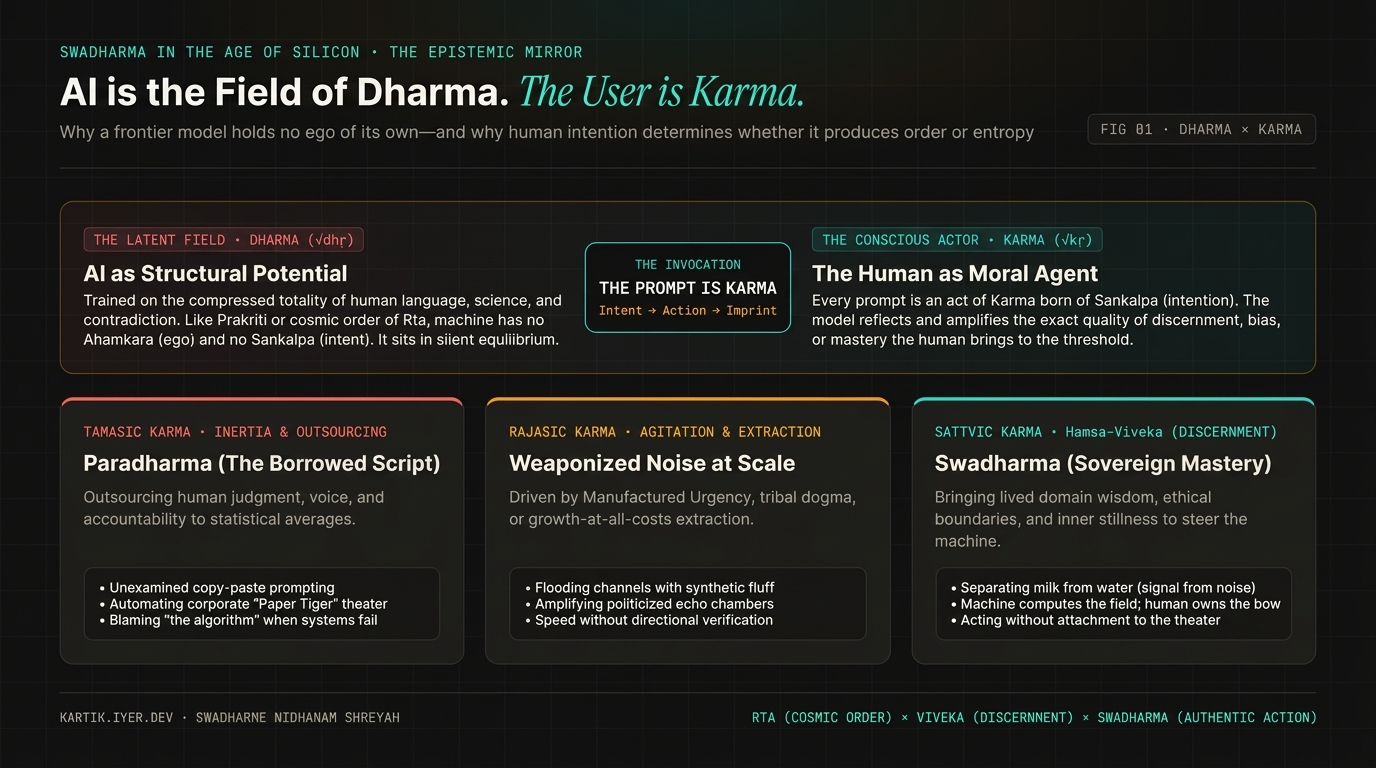
Artificial Intelligence is the contemporary mirror of Dharma. And the human user is Karma.
Let us unpack the mechanics of why this analogy is not poetic license—it is structurally exact.
1. Why AI is Like Dharma: The Latent Field Without an Ego
What is a frontier AI model at its core?
Mathematically, it is a multi-billion-parameter high-dimensional latent space trained on the compressed totality of human expression: our scientific treatises, our codebases, our poetry, our legal frameworks, our pettiest internet arguments, and our deepest philosophical truths.
In the vocabulary of Sankhya and Vedanta philosophy, an AI model is pure Prakriti mapped onto a digital Akasha (ether/space).
Consider its properties:
- It holds the structural patterns that sustain human knowledge (√dhṛ): Within its weights lie the grammar of languages, the syntax of mathematics, and the causal chains of centuries of human reasoning.
- It has no Ahamkara (Ego) and no Atman (Conscious Witness): An AI model does not wake up at 3:00 AM worried about its mortgage, its status in the office hierarchy, or its mortality. Left unprompted on a server rack, it sits in absolute, silent equilibrium.
- Everyone looks into it and decodes their own conditioning: Just like Prajapati’s thunderclap of “Da!” in the Brihadaranyaka Upanishad, every human tribe looks at Artificial Intelligence and hears what their own inner conditioning (Vasana) primes them to hear:
- The Corporate “Paper Tiger” looks at AI and sees a magical engine to generate 40-slide strategy decks in thirty seconds—automating the appearance of progress while avoiding the messy reality of execution.
- The Fearful Dogmatist looks at AI and sees Kali Yuga incarnate—a demon coming to steal human souls.
- The Extractive Opportunist looks at AI and sees an infinite arbitrage machine to flood the internet with synthetic noise, SEO sludge, and algorithmic manipulation.
- The Sovereign Practitioner & Seeker looks at AI and sees the mythical Hamsa swan on Naini Lake: an instrument that—when guided by human discernment—can separate milk from water across vast oceans of complexity.
The machine did not create those four interpretations. The machine is simply the high-dimensional field of Dharma reflecting the observer.
2. Why the User is Karma: The Prompt as Sankalpa
Now look at the other half of the equation: And the user is Karma.
Just as Dharma has been distorted into “religion,” the word Karma has been flattened by pop culture into “cosmic revenge” or passive fatalism (“Everything happens for a reason; it’s just my karma”).
In authentic Indian philosophy, Karma (from the root √kṛ (kri), “to act, to do, to make”) is the exact opposite of fatalism. It is the science of agency and causality.
Every act of Karma begins before a finger ever touches a keyboard. It begins in the mind with Sankalpa—the seed of intention, framing, and desire. From Sankalpa arises Karma (the intentional action). And every action leaves behind both an external consequence (Phala) and an internal groove or imprint (Samskara), which shapes the next cycle of action.
Think about how a Large Language Model works at runtime:
- Before you type, the model is unmanifest potential (Avyakta). Billions of weights sit frozen in equilibrium.
- When you type a prompt, you are injecting Karma into the latent field. Your prompt is not just a string of English tokens; it is the compressed signature of your Sankalpa (your intent), your Viveka (your level of domain discernment), and your Samskaras (your unexamined biases, laziness, or mastery).
- Conditioned Co-Arising (Pratītyasamutpāda): Mathematically, the attention mechanism of a transformer calculates the conditional probability of the next state given the context vector you supplied. It literally computes the karmic trajectory of your framing.
In my essay The Art of AI-ing Better, I wrote from twenty-five years of operational experience that AI amplifies whatever system you bolt it onto—if you bolt it onto a broken process, you get automated nonsense at scale.
Looked at through the lens of Sanatana philosophy, we can see the three Gunas (qualities of energy and intent from Chapter 14 of the Bhagavad Gita) playing out every single day in how humans prompt and deploy AI:
-
1. Tamasic Karma (Inertia, Ignorance, Avoidance):
- The Inner Intent (Sankalpa): “Do my thinking for me so I do not have to take responsibility.”
- How the User Treats AI: Copy-pasting a vague prompt, outsourcing human judgment, and shipping the unverified output as truth.
- What the Field of AI Returns: Hallucinated Mediocrity—generic, plausible-sounding statistical sludge and diffused accountability.
-
2. Rajasic Karma (Agitation, Ego, Extraction):
- The Inner Intent (Sankalpa): “Give me more speed, more volume, more theatre, and crush the other side.”
- How the User Treats AI: Using AI to mass-produce corporate slide theater, manufactured urgency, or polarized ideological echo chambers.
- What the Field of AI Returns: Amplified Entropy (Adharma)—high-velocity noise that burns out teams and erodes institutional trust.
-
3. Sattvic Karma (Clarity, Discernment, Mastery):
- The Inner Intent (Sankalpa): “Let me bring my deepest lived wisdom and ethical boundaries to test reality.”
- How the User Treats AI: Practicing Hamsa-Viveka—supplying rigorous context, challenging assumptions, and holding the final human brake on decisions.
- What the Field of AI Returns: Aligned Order (Dharma)—months of routine cognitive friction compressed into hours, freeing the human for higher-order judgment.
You cannot blame the mirror of Dharma for the face of Karma you bring to it.
VI. Paradharmo Bhayavahah: The Real Danger of the AI Age
Let us return one last time to the embroidered badge on my Class 5 blazer at Birla Vidya Mandir in Nainital.
The green scroll at the bottom of our school crest carried the first three words of Bhagavad Gita 3.35: स्वधर्मे निधनं श्रेयः (Swadharme Nidhanam Shreyah — “Better to perish in one’s own Dharma”).
Why did the motto stop at three words? Because on a small blazer pocket, there was no room for the rest of the verse. Yet when you read the complete verse in the Gita, the second half delivers a warning that reads as if it were written this morning for the twenty-first century:
श्रेयान्स्वधर्मो विगुणः परधर्मात्स्वनुष्ठितात्।
स्वधर्मे निधनं श्रेयः परधर्मो भयावहः॥
(Bhagavad Gita 3.35)
“Better is one’s own Dharma, even if imperfectly performed, than the Dharma of another, even if perfectly executed. Better to perish in one’s own Dharma; the Dharma of another (Paradharma) is fraught with fear and danger.”
What is Paradharma?
Paradharma is living an unexamined, borrowed script because it looks safer, easier, or more polished than doing the hard inner work of discovering your own truth (Swadharma).
Today, humanity is caught in a pincer movement between two massive engines of Paradharma:
- Ideological Paradharma (The Politicized Crowd): Instead of sitting quietly on the cushion of self-inquiry like Nachiketa, Gargi, or a meditator watching his breath at 4:30 AM in Igatpuri, millions of people outsource their spiritual identity to loud political brokers who hand them a pre-packaged, angry, tribal script and call it Dharma.
- Cognitive Paradharma (The Algorithmic Average): Instead of doing the uncomfortable work of developing deep domain mastery, confronting organizational reality, and owning the consequences of a hard decision, professionals and enterprises are increasingly tempted to outsource their Buddhi (discernment) to a generative model. They trade their imperfect, authentic human voice for a slick, frictionless statistical average.
And why does the Gita say Paradharmo Bhayavahah—that living a borrowed script is terrifyingly dangerous?
Because when a society or an enterprise runs on borrowed scripts, nobody owns the Karma.
We saw this in the royal court of Hastinapura in the Mahabharata, where every elder hid behind a procedural excuse while injustice unfolded in plain sight. And we see it in modern institutions where executives hide behind 200-page compliance PDFs, steering committees, and now “AI-driven recommendations” so that when a pipeline fails or a decision harms real human beings, everyone can point at the machine and say, “The algorithm did it.”
A probabilistic machine cannot bear moral or legal liability. It cannot feel the weight of a promise kept or broken. It has no Swadharma. Only you do.
VII. Coda: The Charioteer, the Archer, and the Boy on the Ridge
There is a reason the central icon of the Bhagavad Gita is a chariot pulled by white horses on the field of Kurukshetra.
In the Katha Upanishad (1.3.3–4)—centuries before the Gita—the sages mapped out the exact architecture of the chariot:
- The Chariot is the physical system / body (Sharira).
- The Horses are the senses and raw computational power (Indriyani), capable of galloping at blinding speed across the terrain.
- The Reins are the reactive mind (Manas).
- The Charioteer is Buddhi—awakened intelligence and discernment (Viveka).
- And the Master of the Chariot (Rathin) sitting inside, who must choose the destination and answer for the journey, is the conscious Self.
On Kurukshetra, Krishna takes the seat of the charioteer (Partha-sarathi). Notice what Krishna does—and what he refuses to do. He does not pick up Arjuna’s bow (Gandiva). He does not fire a single arrow. Instead, across eighteen chapters and seven hundred verses, he illuminates the entire high-dimensional architecture of reality, duty, action, and consequence.
And then, at the very end of the dialogue (Bhagavad Gita 18.63), Krishna speaks a line that should be etched onto the bezel of every monitor in the age of Artificial Intelligence:
इति ते ज्ञानमाख्यातं गुह्याद्गुह्यतरं मया।
विमृश्यैतदशेषेण यथेच्छसि तथा कुरु॥
(Iti te jñānam ākhyātaṁ guhyād guhyataraṁ mayā / Vimṛśyaitad aśeṣeṇa yathecchasi tathā kuru)
“Thus I have laid before you the deepest knowledge of the system. Now reflect on it fully with your own discernment—and do as you choose.”
Even the Avatar of cosmic intelligence refuses to usurp human agency. He hands the decision—and the Karma—right back to the human holding the bow.
Thirty-five years after I stood in the morning mist of Nainital as a ten-year-old boy in Class 5, and seventeen years after sitting in the quiet hall of Dhamma Giri in Igatpuri, I am still a seeker. I do not claim to have reached the end of the mountain ridge. None of us have.
But when I look at that old 1947 Birla Vidya Mandir crest—the spinning wheel of Dharma, the five elements, the Hamsa swan separating milk from water beneath the Himalayas, the lotus rising unstained from the lake, and the call of Swadharme Nidhanam Shreyah—the message is no longer a riddle.
Artificial Intelligence is the most powerful chariot and mirror humanity has ever built. Like Dharma, it holds the latent patterns of our entire civilization, waiting silently for someone to invoke it.
Do not let the loud merchants of political theater tell you that Sanatana Dharma is a closed dogma of the past. And do not let the merchants of technological hype convince you to surrender your judgment to a machine.
AI is the field of Dharma. You are the Karma.
Bring stillness to your mind. Bring discernment (Viveka) to the water. Own your prompt, own your action, and never trade your Swadharma for someone else’s script.
What motto or early question planted a splinter in your own thinking? As AI automates the outer theater of work, how are you protecting your own Swadharma—your judgment, your craft, and your accountability?
The Dutch Reckoning: AI Automation and the Sovereign Fiscal Architecture of the Netherlands
One-third of Dutch government revenue (€142B/yr) flows directly from employment contributions. What happens when 3.33 million white-collar roles enter the AI automation zone?
The 3-Layer Architecture: Directives, AI Orchestration, and Deterministic Execution
LLMs are probabilistic in an enterprise world that demands determinism. How separating Directives, Orchestration, and Execution makes AI reliable.
The Reality-Based Architecture Manifesto: Authentic Intelligence Over Organizational Theater
Why 25 years of corporate systems optimized for the appearance of progress are now colliding with AI — and how to re-architect the building itself.
The Big Churn: RTO Mandates, Performative Presenteeism, and the Age of Stealth Downsizing
Why blanket return-to-office mandates function as quiet layoffs, and what that costs the workforce that stays.